Snapshot
This project-based internship used a provided historical dataset to explore loan repayment risk across more than 70 borrower and loan attributes.
The situation
The exercise required a reproducible classification workflow for a high-dimensional lending dataset.
The problem
Missing values, inconsistent fields, outliers, and class-discrimination requirements had to be addressed before comparing model performance.
My responsibility
I prepared the data, explored distributions and relationships, engineered features, compared models, tuned the selected approach, and evaluated discrimination.
Approach
- Engineered debt-to-income, repayment-to-income, and tenure features.
- Compared Logistic Regression, Decision Tree, and Random Forest.
- Used stratified k-fold cross-validation and grid search.
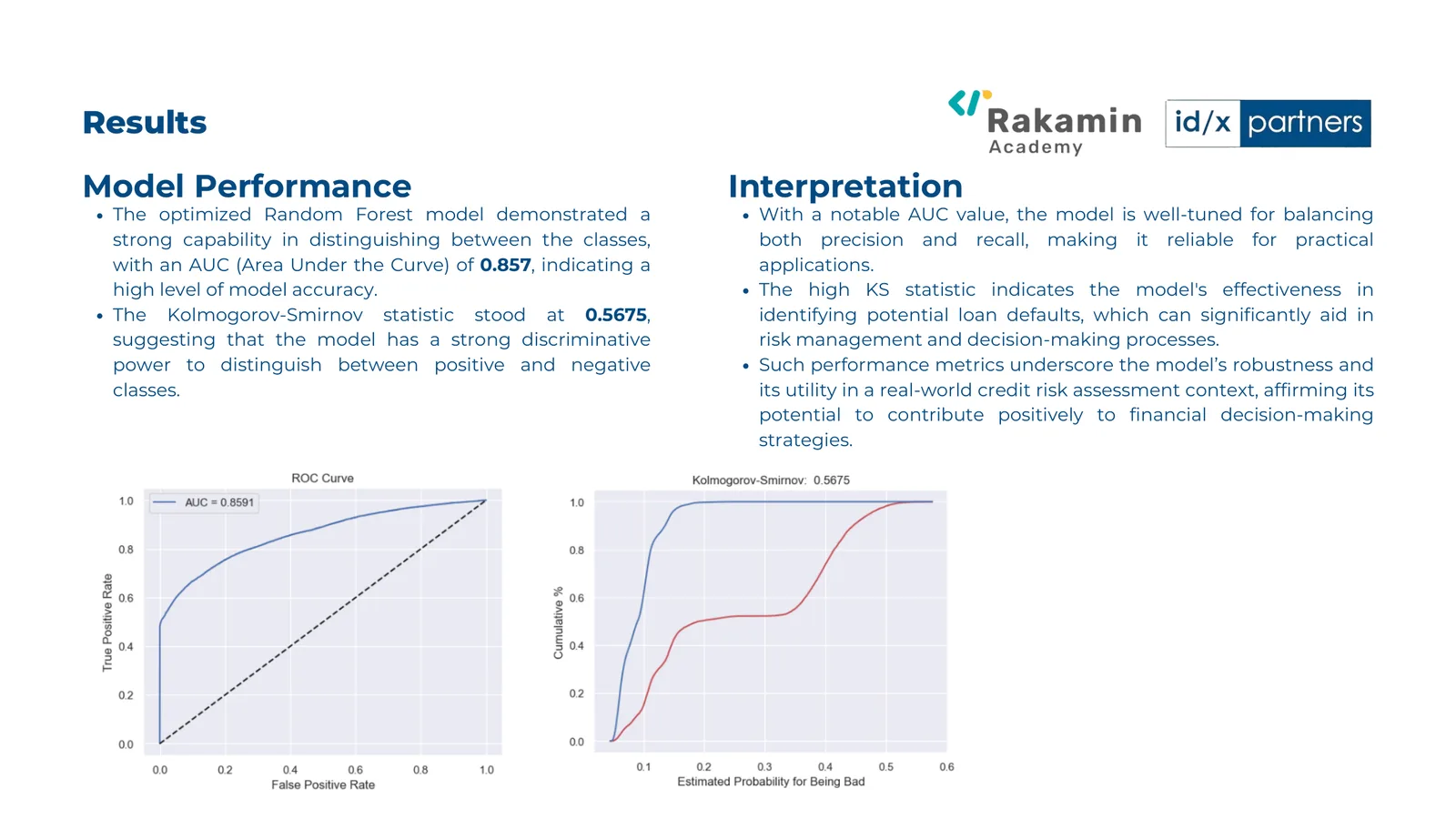
- Evaluated AUC and KS.
Solution
The optimized Random Forest was selected from the compared model families and documented with the evaluation reported by the project.
Outcome
The project report recorded AUC 0.857 and KS 0.5675 on the project dataset.
Limitation: This was not a production lending deployment. Real-world use would require out-of-time validation, bias and fairness testing, calibration, monitoring, and governance.
What I learned
Model discrimination is only one layer of lending risk. Validation design, fairness, explainability, calibration, and operating governance determine whether a model is usable.